
Tag

cyber

Why SD-WAN Has Failed in the Pacific Islands: A Tragic Tale of Broken Promises

By Cisco Meraki, Cisco Viptela, Fiji, ForcePoint, Fortinet, Pacific, PNG, SASE, SD-WAN, Solomon Islands, Versa Networks No Comments

Why SD-WAN Has Failed in the Pacific Islands: A Tragic Tale of Broken Promises

In the vast and beautiful Pacific Islands, staying connected isn’t just a luxury; it’s essential. With islands scattered like stars across the ocean, reliable network connections are critical. The geography itself presents a daunting challenge, with many enterprises operating multiple rural branches that are dependent on steady, reliable WAN connectivity. In recent years, many of these organisations embarked on a hopeful journey towards SD-WAN, dreaming of seamless, high-performance connectivity. However, reality has painted a very different picture.

The Allure and The Betrayal

Fuelled by promises of high-speed, dependable connections, reduced costs, and increased visibility and security, enterprises in the Pacific Islands were quick to adopt SD-WAN solutions. But far from Silicon Valley’s pristine labs, where most of these solutions are conceived, these organisations found that the SD-WAN solutions offered to them performed miserably under the unique conditions of the Pacific.

Enterprises that were promised gold, found themselves with dust. They were led by some MSPs and vendors who, without comprehensive vetting, have ended up locking organisations into solutions that are ill-suited for the region’s specific requirements. This has left CIOs and CTOs feeling deceived, as if their strategic move was nothing but a costly error.

A Shaky Bridge: Basic Traffic Control Isn’t Enough

In the vast landscape of the Pacific Islands, where network conditions are as diverse as the islands themselves, basic traffic control just doesn’t cut it. Companies need a solution that goes beyond simply switching data between links based on pre-set rules. They need a solution that is as dynamic and adaptable as their business operations demand.

Enter Versa Networks. Unlike other SD-WAN solutions that offer rudimentary traffic steering capabilities, Versa Networks employs state-of-the-art traffic engineering techniques designed to maximize the potential of available bandwidth for Pacific Island businesses.

Versa’s SD-WAN solution constantly analyzes the condition of all available WAN links, adapting in real-time to fluctuating network conditions. It doesn’t just blindly follow pre-set rules; it makes intelligent decisions. If one link is congested or experiencing high packet loss, Versa’s system will seamlessly and automatically reroute traffic through a healthier link, ensuring optimal performance and minimal disruption.

This smart approach guarantees that Pacific Island businesses can make the most of their available bandwidth, no matter the circumstances. It means that critical business applications continue to perform at their best, even when network conditions are less than ideal.

In a region where every bit of bandwidth is precious, Versa Networks doesn’t just manage traffic—it engineers the optimal path for it. With this kind of intelligent approach, Pacific Islands’ businesses are empowered to operate efficiently and compete effectively, regardless of their challenging connectivity environment.

The Missing Lifeline: Error Correction and Packet Duplication

In an idyllic setting like the Pacific Islands, network connectivity should ideally be as smooth and uninterrupted as the calmest sea. Reality, however, often tells a different story. With vast ocean distances between islands, and many rural locations with inherent connectivity challenges, data transmission can be stormy, fraught with dropped packets and jitter that spell doom for real-time applications. This is where error correction and packet duplication should come into play as a lifeline, steadying the digital ship—but for many SD-WAN solutions, this lifeline is conspicuously absent.

The Importance of Error Correction

Error correction is like a skilled navigator for a ship—it ensures that the data can reach its destination correctly, even when the waters are rough. In practical terms, error correction mechanisms identify and correct errors as data moves from one point to another in a network. In environments like the Pacific Islands, where connectivity is often unstable due to geographical challenges, this is not just a useful feature; it’s essential. Without error correction, data can become garbled and unusable, causing applications to freeze or crash—a frustrating and costly outcome for businesses that rely on continuous connectivity.

Packet Duplication: The Unsung Hero

Packet duplication is another crucial feature that is, sadly, overlooked by many SD-WAN vendors. It involves sending multiple copies of data packets via different paths, ensuring that even if one packet is lost, another will reach its destination. For businesses in the Pacific Islands that rely heavily on real-time applications such as VoIP or video conferencing, packet duplication can be a game-changer. When the difference between a packet arriving or not can mean the difference between a successful client meeting and a lost opportunity, packet duplication isn’t just a technical feature; it’s a business imperative.

The Versa Advantage

In stark contrast to many competitors, Versa Networks understands the vital importance of these features. It offers robust forward error correction and packet duplication capabilities right out of the box. These features are designed to keep data flowing smoothly and reliably, even in the challenging and varied network conditions that are par for the course in the Pacific Islands.

With Versa, dropped calls and grainy video conferences—common issues when error correction and packet duplication are missing—can become problems of the past. Businesses are able to operate with the assurance that their SD-WAN solution is actively working to maintain the integrity and reliability of their data transmission, regardless of external conditions.

No Extra Charges, Just Extra Reliability

What’s more, Versa Networks doesn’t treat these essential features as pricey add-ons. They are integral to Versa’s SD-WAN offering, reflecting a deep understanding of what businesses, especially those in challenging environments like the Pacific Islands, truly need.

In a world where every packet of data can carry a significant business implication, Versa’s commitment to providing error correction and packet duplication as standard features is a lifeline that many Pacific Island enterprises have been waiting for—a reliable, steady hand guiding them through the unpredictable waters of modern digital connectivity.

Blindfolded Operations: The Analytics Drought

In the modern digital landscape, analytics are akin to a business’s eyes and ears. They offer insights into the network, revealing what is happening at any given moment, and provide the data needed to make informed decisions for the future. For businesses operating in the Pacific Islands, where connectivity is more than just a convenience—it’s a lifeline—these insights are absolutely vital. Unfortunately, this is precisely where many SD-WAN vendors are coming up woefully short.

Many SD-WAN solutions offer little more than a surface-level view of network operations, if they offer any analytics at all. Imagine navigating the treacherous waters of the Pacific blindfolded—that’s what operating with these limited analytics feels like. Businesses are forced to make critical decisions without complete information, making network management more of a gamble than a science.

Furthermore, some vendors that do offer analytics capabilities treat this essential feature as a luxury, attaching hefty additional fees on top of the already substantial costs of the SD-WAN license. For businesses in the Pacific Islands, which are already grappling with high costs and challenging conditions, this can be a significant strain on resources. It’s like buying a car, only to find that seeing through the windshield requires a costly extra payment.

Recognising the fundamental role of analytics in network management, Versa includes best-in-class analytics as a core feature of its SD-WAN solution. But it doesn’t just stop at including them; Versa’s analytics are robust, comprehensive, and designed to meet the unique needs of various enterprise environments, including the challenging conditions in the Pacific Islands.

And here’s the real kicker: these top-tier analytics come at no additional cost. It’s part of the package, a value-add that demonstrates Versa’s understanding that analytics aren’t a ‘nice-to-have,’ but a ‘must-have.’ With Versa, businesses are no longer navigating blind; they have a clear, detailed map of their network’s performance, security status, and much more. This empowers Pacific Island enterprises to make data-driven decisions that enhance performance and security while optimising costs.

In a world where data is king, Versa Networks ensures that businesses in the Pacific Islands are ruling their digital domains with the insight and clarity they deserve—without the shock of hidden, exorbitant fees. It’s a refreshing and necessary shift in an industry where other vendors have left companies parched in an analytics drought.

A Daunting Puzzle: Configuration and Multi-Tenancy

Imagine having to configure each site individually, a nightmarish prospect for any large organisation. Unfortunately, this is the reality with some SD-WAN vendors. Furthermore, they don’t support end-to-end multi-tenancy, which is critical for segmenting and lowering the security posture of branch networks. In contrast, Versa Networks offers an elegant solution with hierarchical multi-tenancy and Role-Based Access Control (RBAC), and it employs a template-based approach to configuration, streamlining large-scale deployments.

MPLS: A Forgotten Requirement

In the whirlwind rush towards embracing the boundless potential of the internet, a critical component of network infrastructure has been pushed to the periphery by many SD-WAN vendors—Multiprotocol Label Switching, or MPLS. While it might be tempting to view MPLS as a relic of a bygone era, the reality, especially for businesses operating across the challenging expanses of the Pacific Islands, is quite the opposite. MPLS remains an essential requirement, serving as a sturdy backbone for reliable, high-quality connectivity. Unfortunately, its significance is often overlooked, leaving Pacific Island enterprises grappling with unnecessary hurdles.

MPLS: The Unsung Hero of Network Stability

MPLS is a protocol for efficient network traffic flow between multiple locations. It does not rely on the public internet, which means it is often more reliable, has lower latency, and is more secure—a critical trio of benefits for businesses in the Pacific Islands. For these companies, where connectivity is not a luxury but a lifeline for operations and survival, MPLS serves as a steady and dependable highway for data.

Why MPLS Matters in the Pacific Islands

In the isolated and expansive geography of the Pacific Islands, broadband internet isn’t always reliable or even available in more rural or remote areas. Even where internet connectivity is accessible, it may not meet the enterprise-grade standards necessary for running a modern business. MPLS, however, provides a dedicated and private path for data, reducing the risk of congestion and ensuring a higher Quality of Service (QoS), relative to broadband.

For critical applications—be it telemedicine in a remote island clinic or real-time financial transactions for a regional bank—MPLS can make the difference between success and failure, between a patient receiving care or a critical delay in services.

The Oversights of Other Vendors

Regrettably, many SD-WAN vendors have shifted their focus almost entirely towards internet-centric solutions, overlooking or downplaying the enduring relevance of MPLS. This oversight is often revealed when organizations, led by promises of improved connectivity at a lower cost, move away from MPLS only to discover that their new SD-WAN solution cannot adequately handle their needs, particularly in terms of security, reliability, and performance.

MPLS in Harmony with SD-WAN

Understanding the unique and varied requirements of Pacific Island enterprises, Versa Networks has crafted a solution that does not force businesses to choose between MPLS and modern SD-WAN technologies. Instead, Versa has developed a unique Hub-Controller design that integrates seamlessly with MPLS circuits.

This design approach allows Pacific Island organizations to leverage the best of both worlds—maintaining the stability, security, and performance of MPLS, while also enjoying the flexibility, visibility, and efficiency of SD-WAN. This is not just an integration; it’s a harmonization that allows for a more robust, adaptable network infrastructure.

No Compromises, Just Comprehensive Solutions

With Versa Networks, MPLS isn’t a forgotten chapter in the history of networking—it’s a current and critical part of a holistic strategy that understands the diverse needs of Pacific Island enterprises. Versa stands apart by recognizing that in the unique and challenging conditions of the Pacific Islands, MPLS is not a negotiable feature—it is a non-negotiable requirement for sustained, successful operations.

A Mirage of Optimisation: The Never-Ending Wait

In the Pacific Islands, where high latency is more than just a fleeting hiccup, many SD-WAN vendors have arrived with grand promises that end up being nothing but hot air. Instead of delivering, they leave businesses stuck with slow and unreliable connections, turning ‘optimisation’ into a waiting game that nobody wins. On the flip side, Versa Networks knows how to handle these choppy waters. Their TCP optimisation technology cuts high latency down to size, making it manageable and effectively reducing that painful lag — a godsend for the satellite links common in remote Pacific areas.

Quality Promised, But Not Delivered: Drowning in a Data Deluge

In the Pacific Islands, where bandwidth is as rare as hen’s teeth, having top-notch Quality-of-Service (QoS) isn’t a ‘nice-to-have’; it’s an absolute must-have. But too many vendors have proven to be all talk and no action, promising smooth sailing but leaving businesses drowning in a flood of data with no lifebuoy in sight. Their SD-WAN solutions fall way short, lacking the smarts to deal with the unique challenges of the Pacific – again. Versa’s advanced QoS systems let network operators sort and prioritise data when the network is clogged up, making sure crucial apps (the ones businesses live and die by) stay up and running. With Versa’s adaptive shaping tech, managing that precious bandwidth becomes a walk in the park, not a trek through quicksand. In a place where staying connected can make or break you, Versa Networks is the mate you want in your corner.

Sprint Networks is Changing the Story

The Pacific Islands are unique, and a one-size-fits-all approach to SD-WAN doesn’t work here. This region needs a solution specifically tailored to its unique challenges.

Sprint Networks understands this. We’ve invested significant time and resources into trying and testing SD-WAN solutions that work in the Pacific Islands. We have skin in the game, and our customers’ success is everything to us. That’s why Sprint Networks has delved deep into the trenches to understand how the frontline staff of Pacific Island enterprises struggle.

We don’t just sell a service; we are committed to making a meaningful difference. With Sprint Networks, the story of SD-WAN in the Pacific Islands can be one of resilience, innovation, and success. We are dedicated to writing this new chapter, putting the unique needs of the Pacific Islands at the forefront of our solutions.


Every Branch in the Pacific Islands Deserves a Firewall: Why Cybersecurity Matters

By Network Security, PNG, SASE, SD-WAN, Versa Networks No Comments

Every Branch in the Pacific Islands Deserves a Firewall: Why Cybersecurity Matters

Why Cybersecurity Matters

Remote Branches in the Pacific Islands are often left behind when it comes to technology and infrastructure. This leaves these branch Networks vulnerable to cyberattacks, as they don’t have the same level of protection as the head office. Cybersecurity is a critical issue that needs to be addressed to keep these branches safe.

These branch offices may not be handling sensitive data or critical infrastructure, but they are still susceptible to cyber attacks. In fact, many attackers will target these types of branch offices because they know that they are often left unprotected.

That’s why it’s so important to make sure that every branch office in the Pacific Islands has a Next-Generation Firewall in place. With an integrated SD-WAN (Software-Defined WAN) and Next-Generation Firewall, these branch offices can be protected from the ever-growing threats of cyber attacks.

The right Secure SD-WAN solution can play a key role in providing superior protection against the latest Cyber Threats and providing better connectivity for Business Critical Applications. 

Benefits of having a Next-Generation Firewall at the Local Branch

A Next-Generation firewall provides improved data performance and better security for the branch. Next-Generation firewalls also eliminate the need to hairpin traffic back to the central site for inspection which can improve WAN performance. 

Not all SD-WAN is created equal. Secure SD-WAN uniquely designed to meet the Pacific Islands’ needs are far and few between. The right SD-WAN solution will not only provide the security but it will also optimise traffic across different WAN links, including MPLS, LTE, VSAT and even broadband. This can help to improve performance and reduce costs.

Whether your branch is running TPNG, Digicel, TFL or Vodafone – the right SD-WAN can give you end-to-end visibility of your traffic flows and security profiles. 

Next-Generation firewalls are designed to protect against Cyber Threats

Next-Generation firewalls are designed to protect against the ever-evolving landscape of Cyber Threats. They provide comprehensive security features, including application control and intrusion prevention, that defend against known and unknown attacks. In addition, Next-Generation firewalls can be integrated with SD-WAN solutions to further secure branch office locations.

The Pacific Islands are a critical region for many businesses and organisations. The Next-Generation Firewall is an important tool to help ensure the safety and security of these operations. By implementing a Next-Generation firewall, businesses and organisations can protect their assets, data, and reputation from the damaging effects of cyber attacks.

If you’re doing business in the Pacific Islands, don’t wait until it’s too late to invest in a Next-Generation firewall. Contact us today to learn more about our SD-WAN and Next-Generation Firewall solutions and how they can help keep your data safe from cyber threats.

Thank you for reading! We hope this blog post has helped highlight the importance of Cybersecurity in the Pacific Islands region.

We welcome your feedback, you can write to us at
info@sprintnetworks.com OR
Visit our website- https://www.sprintnetworks.com.au/png/

Strategies for improving Data connectivity for Rural branches in the Pacific Islands

By Pacific, PNG, SD-WAN No Comments

Strategies for improving Data connectivity for Rural branches in the Pacific Islands

Strategies for improving Data connectivity for Rural branches in the Pacific Islands

One of the key challenges that businesses face in the Pacific Islands is poor and expensive WAN connectivity. This is a particular issue for businesses with rural branches, as they often have to rely on MPLS and satellite links which are both slow and expensive. MPLS circuits are often oversubscribed and congested in the Pacific Islands, which can lead to poor performance and reliability. This is a particular problem for businesses that rely on VoIP or other real-time applications.

Options to consider

One way to improve data connectivity for businesses in the Pacific Islands is to invest in alternative WAN technologies such as VSAT. VSAT can provide a much higher level of bandwidth and reliability than MPLS, and is often more cost-effective as well. Another option is to use SD-WAN (Software-Defined WAN) technology to optimise traffic across different WAN links, including MPLS, LTE, VSAT and even broadband. This can help to improve performance and reduce costs.
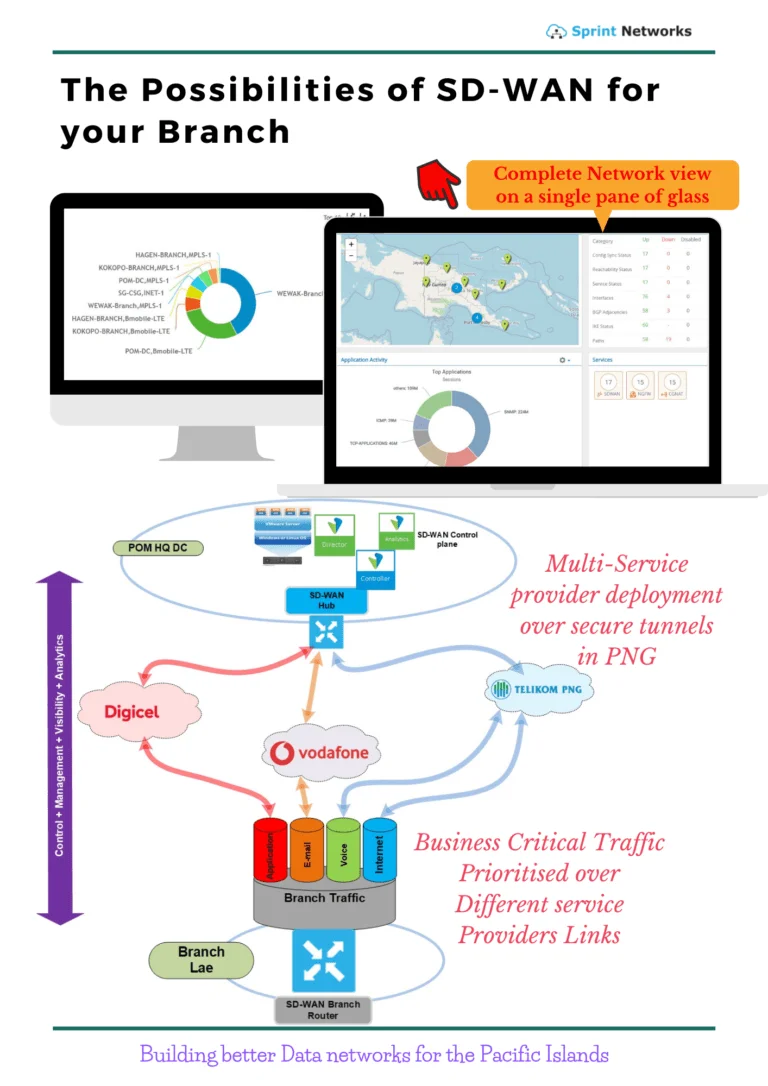
Benefits of SD-WAN usage at Rural Branches in the Pacific Islands.

Strategies for improving Data connectivity for Rural branches in the Pacific Islands

SD-WAN can be a major boon for businesses in rural areas of the Pacific Islands that often struggle with data connectivity. Use SD-WAN to intelligently use your bandwidth and improve data connectivity for businesses in the Pacific Islands. SD-WAN can help make better use of expensive MPLS circuits and ensure that business-critical applications have the throughput they need. SD-WAN can be a major enabler of business growth and development in these rural areas.

14 Benefits of using SD-WAN at Rural Branches in the Pacific Islands.

        1. SD-WAN can help rural businesses in the Pacific Islands make better use of their expensive MPLS circuits.
        2. SD-WAN can improve data connectivity for businesses in the Pacific Islands by providing a more secure connection.
        3. SD-WAN can help to reduce the cost of data connectivity for businesses in the Pacific Islands by using hybrid WAN services including Broadband Internet, VSAT and LTE.
        4. SD-WAN can aggregate all available WAN circuits and improve throughput.   
        5. SD-WAN can ensure that business-critical applications have the throughput they need.
        6. SD-WAN can help rural businesses in the Pacific Islands better compete with urban businesses.
        7. SD-WAN can help to reduce the time it takes to connect to data services for businesses in the Pacific Islands.
        8. SD-WAN can help rural businesses in the Pacific Islands grow and develop.
        9. SD-WAN can help to reduce the risk of data breaches for businesses in the Pacific Islands.
        10. SD-WAN can be a major enabler of business growth and development in rural areas of the Pacific Islands.
        11. SD-WAN can help to improve competitive advantage by providing a more reliable and faster connection.
        12. SD-WAN can improve customer satisfaction by providing a more reliable connection.
        13. SD-WAN can improve employee productivity by providing a more reliable and faster connection.
        14. SD-WAN can help to increase sales by providing a more reliable and faster connection.

SD-WAN in conjunction with traffic steering techniques and TCP optimisation can ensure that the precious bandwidth is used intelligently to improve branch performances. This will help businesses in the Pacific Islands to make better use of their data connectivity and grow their businesses.

Here’s an informative Case Study Why you should care about SD-WAN in PNG and Pacific?

If your Branches are struggling to keep up with your enterprise goals and Security is your highest priority, then do you believe SD-WAN will be a game changer? Let us know

We welcome your feedback, you can write to us at
info@sprintnetworks.com OR
Visit our website- https://www.sprintnetworks.com.au/png/

Twenty Things For Ransomware Protection

By Network Security No Comments

We are at an especially vulnerable moment in our transition to a digital economy. As mentioned in the last blog, Australia government has an announcement on cybersecurity issues recently happened. It points out an interesting point that the biggest problem is the human factor, especially when it comes to ransomware. It becomes very critical that each organization needs to take steps to protect the network or network attached elements.

While each corporation has its own network environment, without talking about too much details, here are 20 things from Fortinet experts that any organisation can begin to implement today to reduce their risk from ransomware and other advanced threats.

1.   Wherever possible, patch and update operating systems, devices, and software. Make this a priority for your remote workers – especially those using personal devices to connect to the corporate network.
2.   For devices that can’t be patched, ensure that appropriate proximity controls and alerts are in place.
3.   Make sure that all endpoint devices have advanced security installed, such as anti-exploit and EDR solutions.
Update
Access
4.   Also make sure that access controls, such as multifactor authentication and even Network Access Control solutions are in place
5.   Use NAC to inspect and block bring-your-own-devices that do not meet security policy
6.   Segment your network into security zones to prevent the spread of infection and tie access controls to dynamic segmentation.

7.   Use inventory tools and IOC lists to prioritize which of your assets are at the most risk.

8.   Update your network IPS signatures, as well as device antivirus and anti-malware tools.
9.   Back-up systems and then store those backups offline – along with any devices and software you may need in the event of a network recovery.
10.   Make sure that ransomware recovery is part of your BCDR, Identify your recovery team, run drills, and pre-assign responsibilities so systems can be restored quickly in the event of a successful breach.
11.   Update your email and web security gateways to check and filter out email attachments, websites, and files for malware.
Ransomeware
virus
12.   Make sure that CDR (content disarm and recovery) solutions are in place to deactivate malicious attachments.
13.   Use a sandbox to discover, execute, and analyze new or unrecognized files, documents, or programs in a safe environment.
14.   Block advertisements and social media sites that have no business relevance
15.   Use zero-trust network access that includes virus assessments so users can’t infect business-critical applications, data, or services
16.   Use application whitelisting to prevent unauthorized applications from being downloaded or run.
17.   Prevent unauthorized SaaS applications with a CASB solution.
18.   Use forensic analysis tools to identify where an infection came from, how long it has been in your environment, ensure you have removed all of it from every device, and ensure it doesn’t come back
19.   Plan around the weakest link in your security system – the people who use your devices and applications. Training is essential but limited. Proper tools, such as secure email gateways, for example, can eliminate most if not all phishing emails and malicious attachments.
20.   Leverage people, technology, and processes to quickly gather threat intelligence about active attacks on your networks and act on it, using automation where possible. This is crucial to stopping an advanced attack in its tracks.

Make your network intelligent against threats with Sprint Networks. We aim to secure Australian businesses and institutions from all malicious activities that can take advantage of network vulnerabilities.

Contact Us now for an industry-leading security solution.

If you have questions, please drop us an e-mail at info@sprintnetworks.com

Implementation Of Network Access Control

By Network Security No Comments

The current perimeter solution could bring a lot of value to your organisation by defending threats and attacks at the perimeter. However, with todays sophistication of attackers, systems tend to be cracked from the internal network. Hence, a Network Access Control (NAC) tool can be useful inorder to connect the end users with the right authentication. It can be tempting to purchase a off the shelf NAC product and install it on your hardware. This could be catastropic to your network security as the solution is not catered to your network as well as its intended use. Implementing an appropriate NAC will save the organisation the trouble of spending valuable time and money in recovering and detection of threats by taking the steps necessary to plug any vaunarabilities in the network. This article aims to give a step by step guideline to any network security professional to design and plan an entire NAC solution.

Steps to Implement a NAC Solution

1. Survey your network

It is recommended to perform a survey of all the endpoints within your network. That should include, but not limited to, all your server, network devices, user PCs, and piece of equipment that has a leg into your network and is able to access your digital resources. Without this kind of information, NAC would struggle to protect the entire organization, and the system admins will need to spend lots of their time and energy to implement and troubleshoot. 

2. User Identities

It is a must to have a solid plan about how you will manage user credentials and identities within the organisation. You internal directory system should be able to verify user identities. All users should be manageable and have their account information details. After setting up all the account details and understanding the role of each user, then, you can move to the next step to determine how the permission or roles be allocated.

User Identity

3. Designing policies

Creating permission policies by using Principle of Least Privilage (PoLP) rules. It means you should only grant access at the mandatory level required for the individual users to perform their daily duties. This is one of the most critical steps as you do not want to open your systems up to attack through small security gaps that you are not even aware of. Having all teams together and making a concrete structure in which everyone would be able to access the network securely.

4. Apply Permissions

Once the permissions determined, you can have the permission policies ready by integrating your existing directory system or importing your permission policies directly. All valid users will be registered to the NAC system, and all activities can be recorded and tracked. Illegitimate access will be blocked at the edge of your network.

Permission

5. Maintaining policies

Managing network access controls is not a one-off activity. As there would be staff and network changes constantly, network admin must constantly monitor security operations and adjust policies based on business requirements and network evolvement.

How to choose a Network Access Control solution

As discussed earlier, today’s NAC products aim to cover a wide range of use cases to boost the overall security of your enterprise. That can make it challenging to find the right solution for your company, especially if you don’t know what your internal security weaknesses are.

control System

Make your network intelligent against threats with Sprint Networks. We aim to secure Australian businesses and institutions from all malicious activities that can take advantage of network vulnerabilities.

Contact Us now for a industry-leading NAC solution.

If you have questions, please drop us an e-mail at info@sprintnetworks.com

Network Access Control

By Network Security No Comments

What is NAC?

Given the current businesses reliance on tech on a daily basis, many organisations feel the need like to tackle the cyber issue from various angles. Traditional ways are to procure a simple antivirus solution, perimeter firewalls, and use a separate system for managing access permissions. However, with the heavily use of Wi-Fi and mobile devices, the trend has shifted to embrace the NAC, Network Access Control.

What is Network Access Control, NAC?

Network Access Control is the act of keeping unauthorized users and devices out of a private network. Organisations that give certain devices or users from outside of the organization occasional access to the network can use network access control to ensure that these devices meet corporate security compliance regulations.

NAC solutions are designed to help network admin to boost the overall security level for internal users. That would guarantee the right person would get the right permissions with right authentication methods.

What are common use cases for network access control?

If an organization is under any of the following circumstances, they need to think cautiously about network access control to secure the enterprise network:

  • Bring Your Own Device (BYOD):
  • Any organization that allows employees to use their own devices to connect to the corporate network or take the corporate devices home should think about when those devices connect back to the company sensitive network. Each device could be or create a vulnerability that which will encourage the cyber criminal to bypass the traditional security controls.

  • Network access for non-employees:
  • Some organizations need to grant access to people or devices that are outside of the organization with many reasons, like conferences, contractors or visitors. But, those access with different purposes should not be subject to the same security controls. Especially for contractors, they might need the access to the corporate network from time to time, and you will not want to grant the same level of access which you employees have for a short time project. That should be under the monitor and with proper level of authentication.

  • Network access without Port Security:
  • Traditional network access will require the end users to connect to the floor switched to gain the access to the network. But, some of the access are not under port security policies. That means anyone can access the network when they plug into the same port without necessary authentication to fake the employee permissions. For those ports which are exposed and hard to manage as constant changes happened, it is necessary to use NAC to grant the right authorization to the person no matter where they connect.

  • IoT devices:
  • The Internet of Things, as known as IoT, has given rise to a proliferation of devices that may fly under the radar of traditional security controls. They could locate outside of your physical buildings, but they still be able to connect to your network through some forms of transmission media. As a non-standardized industry, Cyber criminals can easily exploit these overlooked devices to find their own ways into your network without getting any kinds of permissions. Network access controls plays a important role in your edge security.

    Make your network intelligent against threats with Sprint Networks. We aim to secure Australian businesses and institutions from all malicious activities that can take advantage of network vulnerabilities.

    If you think you are at risk!

    If you have questions, please drop us an e-mail at info@sprintnetworks.com